- Home
- Blog
- Does Hard Water Damage Water Heaters? What Homeowners in New Braunfels and San Antonio Should Know
Does Hard Water Damage Water Heaters? What Homeowners in New Braunfels and San Antonio Should Know
Explore how hard water damages water heaters and affects their efficiency. Learn what homeowners in New Braunfels and San Antonio can do to protect their systems.
Does Hard Water Damage Water Heaters?
If you've ever noticed white buildup on your faucets, spots on your dishes, or crusty deposits around plumbing fixtures, you've already seen the effects of hard water.
What many homeowners don't realize is that the same minerals causing those visible deposits are also building up inside their water heater every single day.
At Plunger Pros, we regularly replace water heaters throughout New Braunfels, San Antonio, Schertz, Cibolo, Bulverde, Spring Branch, Canyon Lake, and surrounding areas that have suffered years of hard water buildup. In many cases, the damage isn't visible until the water heater starts making noise, runs out of hot water, develops a leak, or fails entirely.
The short answer is yes: hard water can absolutely damage a water heater.
It can reduce efficiency, decrease hot water production, increase utility costs, damage internal components, and significantly shorten the lifespan of both traditional tank and tankless water heaters.
Let's look at why this happens and what homeowners can do to protect their investment.
Why Hard Water Is Such a Problem in Central Texas
Hard water contains elevated levels of dissolved minerals, primarily calcium and magnesium.
As groundwater moves through limestone and mineral-rich formations, it picks up these minerals before entering municipal water systems and private wells.
Throughout New Braunfels, San Antonio, Canyon Lake, Spring Branch, Bulverde, and many surrounding communities, hard water is extremely common.
While these minerals are generally safe to drink, they create ongoing problems inside plumbing systems.
Every time water is heated, a portion of those dissolved minerals separates from the water and begins accumulating inside the equipment.
The hotter the water gets, the faster this process occurs.
Over months and years, the buildup becomes significant.
What Happens Inside a Water Heater Over Time?
Many homeowners never see the inside of a water heater, so it's difficult to understand how severe the buildup can become.
Here's what typically happens.
Step 1: Water Enters the Tank
Fresh water enters the water heater carrying dissolved minerals.
Initially, everything functions normally.
Step 2: Minerals Begin Settling
As water is heated, calcium and magnesium begin separating from the water and settling to the bottom of the tank.
Step 3: Sediment Accumulates
The sediment layer gradually becomes thicker.
What starts as a thin coating eventually becomes inches of buildup.
Step 4: Efficiency Drops
The heating system must work harder to transfer heat through the accumulated scale and sediment.
Step 5: Components Overheat
Because heat transfer becomes less efficient, internal components experience higher operating temperatures.
Step 6: Premature Failure Occurs
Eventually, heating elements, burners, heat exchangers, or the tank itself begin to fail.
This process happens slowly enough that many homeowners don't notice the damage until major symptoms appear.
Signs Hard Water Is Damaging Your Water Heater
Reduced Hot Water Volume
One of the most common complaints we hear is:
"We don't have as much hot water as we used to."
Sediment takes up space inside the tank.
The more sediment present, the less room remains for actual hot water storage.
A family that once had enough hot water for multiple showers may suddenly find themselves running out much sooner.
Rumbling, Popping, or Crackling Sounds
If your water heater sounds like it's making popcorn, there's a good chance sediment buildup is involved.
As water trapped beneath the sediment layer heats up, steam bubbles form and force their way through the buildup.
This creates:
Popping noises
Crackling sounds
Rumbling sounds
These noises are often one of the earliest warning signs that maintenance is overdue.
Slow Recovery Time
A water heater covered in scale cannot transfer heat efficiently.
As a result:
Water heats more slowly
Recovery takes longer
The unit runs longer cycles
Many homeowners notice this as longer waits between showers or slower hot water recovery after doing laundry.
Higher Utility Bills
When a water heater loses efficiency, it consumes more energy.
Whether your system uses gas or electricity, sediment buildup forces it to work harder.
That means:
Longer burner run times
Longer element operation
Increased gas usage
Increased electric consumption
Over time, this translates into higher monthly utility bills.
Water Heater Leaks
Eventually, sediment buildup can contribute to tank failure.
As sediment accumulates on the bottom of the tank, it creates hot spots where the steel is repeatedly exposed to excessive temperatures.
Over time, this can weaken the tank and contribute to leaks.
Once a tank begins leaking, replacement is generally required.
What We Found Inside a Water Heater We Replaced in San Antonio
Recently, we replaced a leaking water heater for a homeowner in San Antonio.
The water heater had already begun leaking and was due for replacement.
As we started draining the unit, something immediately stood out.
Even after draining the water, the tank remained surprisingly heavy.
This is often one of the first signs that significant sediment buildup is present.
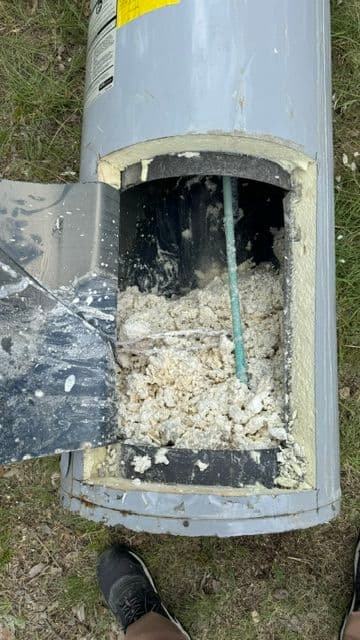
After removing the water heater, we cut the tank open to inspect the interior.
Inside, we found substantial hard water buildup throughout the tank.
Large amounts of white mineral deposits and sediment had accumulated over the years.
The amount of buildup was significant enough that it had likely been affecting efficiency and performance long before the leak occurred.
Situations like this are incredibly common throughout our service area and demonstrate what hard water can do when maintenance is neglected.
How Hard Water Affects Gas Water Heaters
Gas water heaters heat water from beneath the tank.
As sediment accumulates at the bottom, it forms an insulating layer between the burner and the water.
The burner must work harder to push heat through this layer.
Over time, this can create excessive temperatures in localized areas of the tank.
These repeated heating cycles can contribute to:
Reduced efficiency
Increased fuel consumption
Tank stress
Premature leaks
How Hard Water Affects Electric Water Heaters
Electric water heaters experience a different problem.
Their heating elements are submerged directly in the water.
As scale accumulates on the elements, it acts like insulation.
The element must operate at higher temperatures to produce the same heating effect.
This can lead to:
Burned-out heating elements
Increased energy usage
Slower heating
Reduced hot water production
We've replaced countless failed heating elements that were heavily coated in scale.
How Hard Water Affects Tankless Water Heaters
One of the biggest misconceptions homeowners have is that tankless water heaters don't require maintenance.
In reality, tankless water heaters are often more vulnerable to hard water than traditional tank systems.
Inside every tankless water heater is a heat exchanger.
This heat exchanger contains narrow pathways that rapidly heat water as it passes through the unit.
Because these pathways are relatively small, scale buildup can become a major problem.
Over time, hard water can:
Restrict water flow
Reduce efficiency
Cause ignition problems
Trigger error codes
Cause overheating
Damage the heat exchanger
In severe cases, heat exchangers can develop pinhole leaks that require expensive repairs or replacement.
This is one reason manufacturers recommend annual tankless flushing.
The Often Overlooked Role of the Anode Rod
Most homeowners have never heard of an anode rod.
Yet it is one of the most important components inside a water heater.
The anode rod is designed to corrode first, helping protect the steel tank from rusting.
Over time, the rod is consumed and must be replaced.
Hard water and certain water conditions can accelerate this process.
When the anode rod is depleted, the tank loses a major layer of protection.
For some homeowners, powered anode rods can provide a longer-lasting solution and help extend the life of the water heater.
How Often Should a Water Heater Be Flushed?
Most manufacturers recommend flushing both tank and tankless water heaters at least once per year.
Regular flushing helps remove:
Sediment
Calcium deposits
Mineral buildup
Debris
This maintenance can improve efficiency, performance, and equipment lifespan.
When Is It Too Late to Flush a Water Heater?
This is an important question.
While annual flushing is beneficial, older water heaters that have never been maintained can be a different story.
If a tank is already heavily deteriorated internally, flushing may expose weaknesses that were previously hidden beneath sediment.
For this reason, we often evaluate the condition and age of the water heater before recommending maintenance.
Every situation is different, which is why professional evaluation is important.
How Long Should a Water Heater Last?
In our area, we commonly see:
Without Regular Maintenance
6 to 10 years
With Regular Maintenance
8 to 12 years or more
Actual lifespan varies based on:
Water quality
Water usage
Maintenance history
Installation quality
Water pressure
How to Protect Your Water Heater from Hard Water Damage
Install a Water Softener
A water softener removes hardness minerals before they reach the plumbing system.
Benefits include:
Less scale buildup
Better efficiency
Longer equipment life
Reduced maintenance
Install Water Filtration
Water filtration can help reduce sediment and other contaminants entering the plumbing system.
Schedule Annual Maintenance
Regular flushing and inspection can identify problems before they become costly repairs.
Test Water Pressure
Excessive water pressure can shorten the lifespan of plumbing fixtures and water heaters.
Join the Plunger Plus Plan
Routine maintenance is one of the best ways to protect your water heater investment.
The Plunger Plus Plan helps homeowners stay ahead of maintenance and catch potential issues before they become expensive repairs.
Protect Your Water Heater Before Hard Water Causes Expensive Damage
Hard water may seem harmless, but over time it can silently reduce efficiency, increase operating costs, shorten equipment life, and lead to premature failure.
If you're noticing reduced hot water, strange noises, rising utility bills, or you're simply unsure about the condition of your water heater, Plunger Pros can help.
We provide water heater maintenance, tankless flushing, water heater replacement, water softener installation, water filtration solutions, and plumbing inspections throughout New Braunfels, San Antonio, Schertz, Cibolo, Bulverde, Spring Branch, Canyon Lake, and surrounding communities.
Plunger Pros
Plumbing done the proper way
M45279
(830) 356-2141
Frequently Asked Questions
Can hard water ruin a water heater?
Yes. Hard water can cause sediment and scale buildup that reduces efficiency, damages components, and shortens equipment lifespan.
Why is my water heater making popping noises?
Popping sounds are commonly caused by sediment buildup inside the tank.
Does hard water affect tankless water heaters?
Yes. Hard water can restrict flow, reduce efficiency, and damage the heat exchanger.
How often should a tankless water heater be flushed?
Most manufacturers recommend annual flushing.
Will a water softener help my water heater last longer?
In many cases, yes. Water softeners reduce mineral buildup and help protect water heating equipment.
How long do water heaters last in New Braunfels and San Antonio?
We commonly see 6–10 years without maintenance and 8–12 years or more with proper maintenance.
Can sediment cause a water heater to leak?
Yes. Sediment can create hot spots that contribute to premature tank failure.
Is annual water heater maintenance worth it?
For most homeowners, annual maintenance is significantly less expensive than premature water heater replacement.